

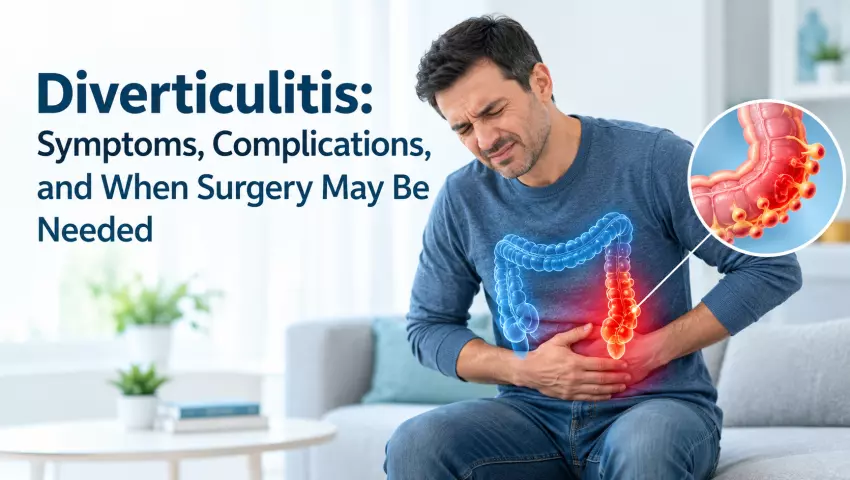
A sudden pain in the lower left side of your stomach, along with fever and nausea, is easy to dismiss as simple gas or acidity. Many people do exactly that and wait for it to pass on their own. But if the pain keeps coming back, it could be diverticulitis, an inflammation of small pouches in the colon wall.
Most mild cases settle with rest, diet changes and medicines. In some people, though, it leads to complications like an abscess or a tear in the bowel, and surgery may become necessary. The hard part is knowing which situation you are in. Catching it early often makes the difference between simple treatment and an emergency.
This guide explains the symptoms, the warning signs and the stage at which surgery is considered. If you are looking for a Colorectal Surgeon in Thrissur, it will help you know what to ask and what to expect. It has been prepared with inputs from Dr. Arun S. Nair, who has 16 years of experience at Gastro Clinic. Read on to know which symptoms can wait and which cannot.
With age, small pouches can form in the wall of the large intestine (colon). These are called diverticula, and having them is known as diverticulosis. It is very common after 40, and most people never have any symptoms.
Diverticulitis happens when one or more of these pouches become inflamed or infected. It is part of what doctors call diverticular disease, and it usually affects the sigmoid colon on the lower left side (sigmoid diverticulitis).
Symptoms usually start mildly and build up over a day or two. Not everyone has all of them. Here is what each one means.
How is it different from gas or acidity? Gas and acidity settle within hours and rarely cause fever. In diverticulitis, the pain stays in one area for days, hurts on pressing and may come with fever or a change in bowel habit. If you notice this combination, get yourself checked instead of treating it at home.
Many people believe diverticulitis always causes left-sided pain. This is not always true. In Asian populations, the pouches are often found on the right side of the colon (cecal diverticulitis). The pain can then be mistaken for appendicitis. If you have right-sided pain with fever, do not assume it is just acidity. Get it examined.
Your doctor will examine your abdomen and may advise blood tests. A CT scan is the most reliable test to confirm diverticulitis and to check for complications. A colonoscopy is usually done a few weeks after you recover, to rule out other conditions of the large intestine. It is not done during an active attack.
Mild, uncomplicated cases are often managed with rest, a temporary liquid or low-fibre diet, pain relief and, in some cases, antibiotics. Please do not start antibiotics on your own. Your doctor will decide whether you need them.
Most people recover without any lasting problem. But in some, the inflammation spreads or keeps coming back, and this can lead to complications:
If you are wondering how diverticulosis turns into diverticulitis, the answer is usually inflammation or infection inside a pouch. The more often it happens, the higher the chance of scarring and complications.
Please go to the nearest hospital or call your doctor immediately if you notice any of these:
Many people ask what stools look like in diverticulitis. They may be loose or hard, and sometimes there is bright red or maroon blood. Any visible blood in stool should be checked by a doctor and never ignored.
The good news is that most people with diverticulitis do not need surgery. It is considered only when the risks of the disease are greater than the risks of the operation. Surgery is of two types: emergency and planned.
This is needed when a complication becomes life-threatening and cannot be controlled with medicines alone.
Here there is no emergency, so you and your Colorectal Surgeon in Thrissur have time to plan. The operation is usually done a few weeks after an attack, once the inflammation has settled. It may be advised when:
It is not based only on the number of attacks. Your surgeon will look at how severe your episodes were, your age, other health conditions and your own preferences. Some people have several mild attacks and do well with diet and lifestyle changes, while others need surgery after one serious attack.
A detailed discussion with a colorectal surgeon helps you decide at the right time, so that surgery is neither done too early nor delayed until it becomes an emergency.
The aim of surgery is to remove the diseased part of the colon, usually the sigmoid colon. This is known as colon resection or sigmoid colectomy. There are two main approaches.
Laparoscopic surgery for diverticulitis is done through small cuts using a camera and fine instruments. Compared to open surgery, it usually means:
Not everyone is suitable for the laparoscopic approach. In emergencies, or when the infection is extensive, an open operation may be safer. Your surgeon will choose the approach after assessing your scans and overall condition. If you are looking for a Laparoscopic Surgeon in Thrissur, it is worth asking whether your case is suitable for this approach.
Recovery varies from person to person, but here is a general idea of what to expect.
In hospital:
At home:
Diverticulitis diet after recovery:
Reducing the chance of future attacks:
Diverticulitis is common and, in most people, manageable. The key is to recognise the symptoms early, avoid self-medication and get the right evaluation. Surgery is needed only in selected situations, such as complications or repeated attacks, and modern laparoscopic techniques have made recovery much smoother.
If you have repeated lower abdominal pain, fever or changes in your bowel habits, do not wait for it to become severe. Consult an experienced Gastroenterologist in Thrissur for proper evaluation. At Gastro Clinic, Dr. Arun S. Nair, with 16 years of experience, can guide you on whether medicines, diet changes or surgery is the right path for you.


Cosmopolitan Rd, D N, AR Menon Road, Cherumukku, Chembukkav, Thrissur, Keralam 680022
Church Post Office Road near Parumala, Thiruvalla, Kerala 689626
+91-9539988886
drarungastrosurgeon@gmail.com.
© 2026 Dr. Arun Gastro Surgeon | All rights reserved | Website Designed by Digital Mogli LLP
